Recent co-folding models such as OpenFold3, Boltz-2, and Protenix-v1 can predict structures for protein–ligand and protein–protein complexes with accuracy that begins to support practical drug discovery work. These predictions are most useful when they are embedded directly into the iterative design cycles used in pharmaceutical R&D.
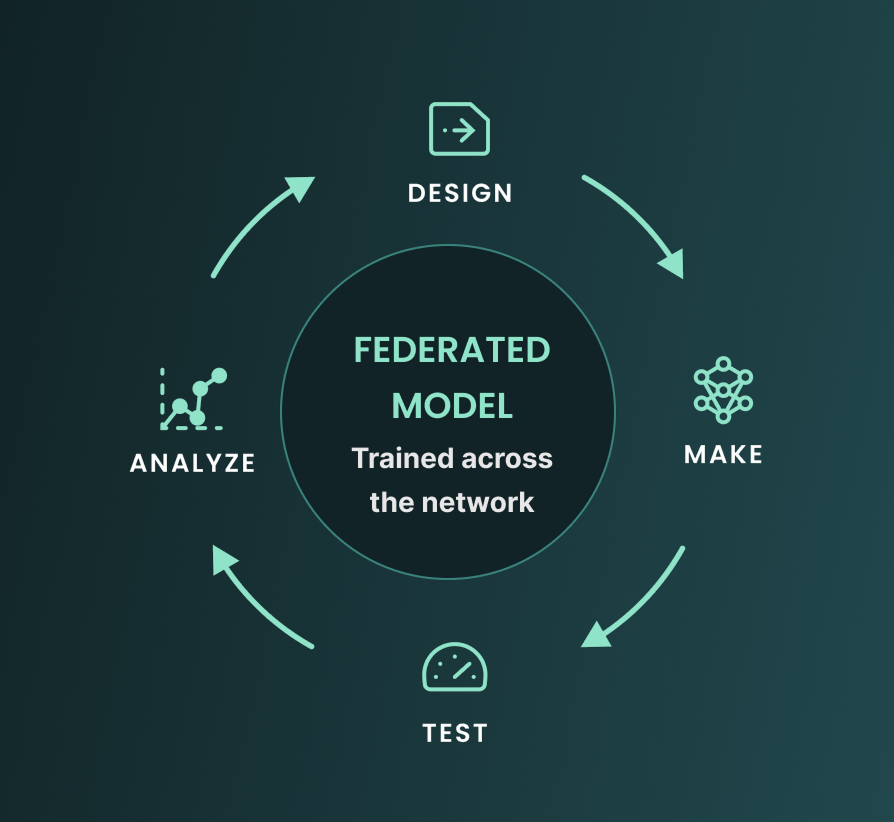
Lead optimization provides such a setting. During this phase of a discovery program, chemists work with a defined chemical series and repeatedly refine it through design–make–test–analyze (DMTA) cycles. Each cycle generates new candidate compounds. Because the practical synthesis of compounds is expensive and time-consuming, major efficiencies are only felt when a workflow is able to accurately prioritize which compounds to synthesize.
Structural predictions provide additional information that helps guide these decisions. When a predicted structure suggests how a ligand interacts with a binding pocket, it can inform both the design of new compounds and the selection of candidates for synthesis.
ApherisFold was developed to support medicinal and computational chemists in carrying out these activities within pharmaceutical environments. The platform allows teams to run co-folding models locally, evaluate them on proprietary datasets, fine-tune them on program-specific chemistry, and inspect predicted structures all within the same workflow.

Structure prediction in ApherisFold
Using structural predictions to guide compound design
Lead optimization begins with a compound that interacts with the target protein but does not yet satisfy the requirements of a drug candidate. Improvements may involve stronger affinity, better selectivity, and more favorable pharmacokinetic and pharmacodynamic outcomes.Structural predictions provide a view of how the ligand occupies the binding pocket. From this view, chemists can identify possible modifications. A nearby residue may be capable of forming a hydrogen bond. Alternatively, hydrophobic contacts might be strengthened by extending the ligand into an adjacent empty pocket volume.These observations translate into design hypotheses that can be tested in the next DMTA cycle. A modification is proposed, candidate compounds are designed around that modification, and structural predictions help evaluate whether the idea is geometrically plausible.
Evaluating candidate molecules before synthesis
Once a design hypothesis has been formulated, chemists typically generate many candidate structures that explore possible modifications. Enumeration of reaction libraries, medicinal chemistry design, and generative models can easily produce hundreds or thousands of compounds.As only a small subset of these compounds can be synthesized, computational evaluation plays an important role in narrowing down the list.Co-folding models can predict how candidate ligands interact with the target protein. Predictions that violate basic structural constraints, such as unrealistic geometries or loss of key interactions, can be excluded early. Remaining candidates can then be examined in greater detail.This filtering stage allows discovery teams to focus experimental resources on high quality compounds that are structurally consistent with the original design hypothesis.

Compound table with 2D structure and associated metrics. In hand: 10 potential ligands that fulfil the design criteria and would test the hypothesis if synthesized
Inspecting predicted binding modes before compound selection
After computational filtering, medicinal and computational chemists typically examine the remaining candidates individually. This visual inspection often focusses on small structural differences which determine the final compound selection.Predicted structures can be overlaid to compare how different molecules interact with the protein pocket, and the most promising compounds chosen. For example, a hydrogen bond in one compound may form at a slightly less favourable angle than another. A compound might have a large group which extends into solvent, and is therefore more inefficient at binding overall. Another molecule may preserve the same interaction pattern while using a simpler scaffold.These details are difficult to capture with scoring metrics alone. Visual inspection, and “human-in-the-loop,” therefore remains an important step before compounds are selected for synthesis and experimental testing.
Benchmarking and fine-tuning models on proprietary data
Reliable predictions depend on how well a model performs for the targets and chemical space of a particular discovery program. Public benchmarks provide general comparisons between methods, but they rarely reflect the specific proteins and ligands present in a company’s internal projects.For this reason, pharmaceutical teams often evaluate models using proprietary structural datasets. ApherisFold allows researchers to run such benchmarking experiments directly inside their own environments.The platform also supports fine-tuning workflows, which are particularly valuable during lead optimization. As experimental structures accumulate for a chemical series, these structures can be used to adapt the model to the relevant target and chemistry. This process improves prediction quality within the structural space that matters for the program.Fine-tuned models therefore complement general-purpose models by increasing reliability for the specific systems under investigation.

Benchmarking results
Running and comparing multiple co-folding models
Different co-folding models may perform differently depending on the structural problem. For this reason, many teams evaluate several models in parallel.ApherisFold provides access to multiple state-of-the-art co-folding models within the same environment, including:
- OpenFold3
- Boltz-2
- Protenix-v1
- Proprietary global, or project-specific, fine-tuned models
Running these models side-by-side allows researchers to compare predictions across architectures and checkpoints. Benchmarking results can be recalculated when new model versions are released, allowing teams to track improvements over time.This approach creates a consistent framework for evaluating structural prediction methods as the field evolves.
Protenix-v1 expands the available model portfolio
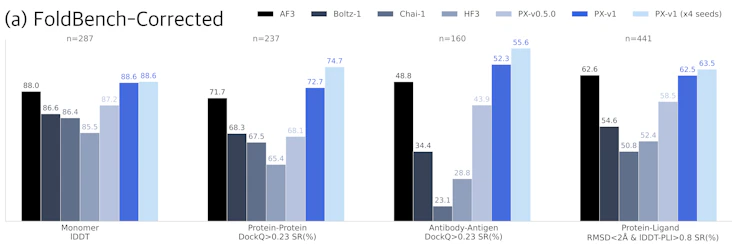
The addition of Protenix-v1 provides a new open-source option for structural prediction workflows. The model is reported to reach AlphaFold3-level performance under matched training conditions and demonstrates competitive results across several tasks relevant to drug discovery, including protein–protein docking, antibody–antigen interface prediction, and protein–ligand co-folding.An important characteristic of Protenix-v1 is its inference-time scaling behavior. Increasing the sampling budget improves prediction accuracy in a predictable manner, which allows researchers to allocate additional compute resources to difficult structural problems.Within ApherisFold, Protenix-v1 can be evaluated alongside OpenFold3 and Boltz-2 using identical datasets and evaluation procedures. This makes it possible to determine which model performs best for a particular target class or ligand type. Read our Protenix-v1 announcement for more details on its performance.
Protenix-V1 benchmark
Improving structural models through the AISB federated OpenFold3 initiative
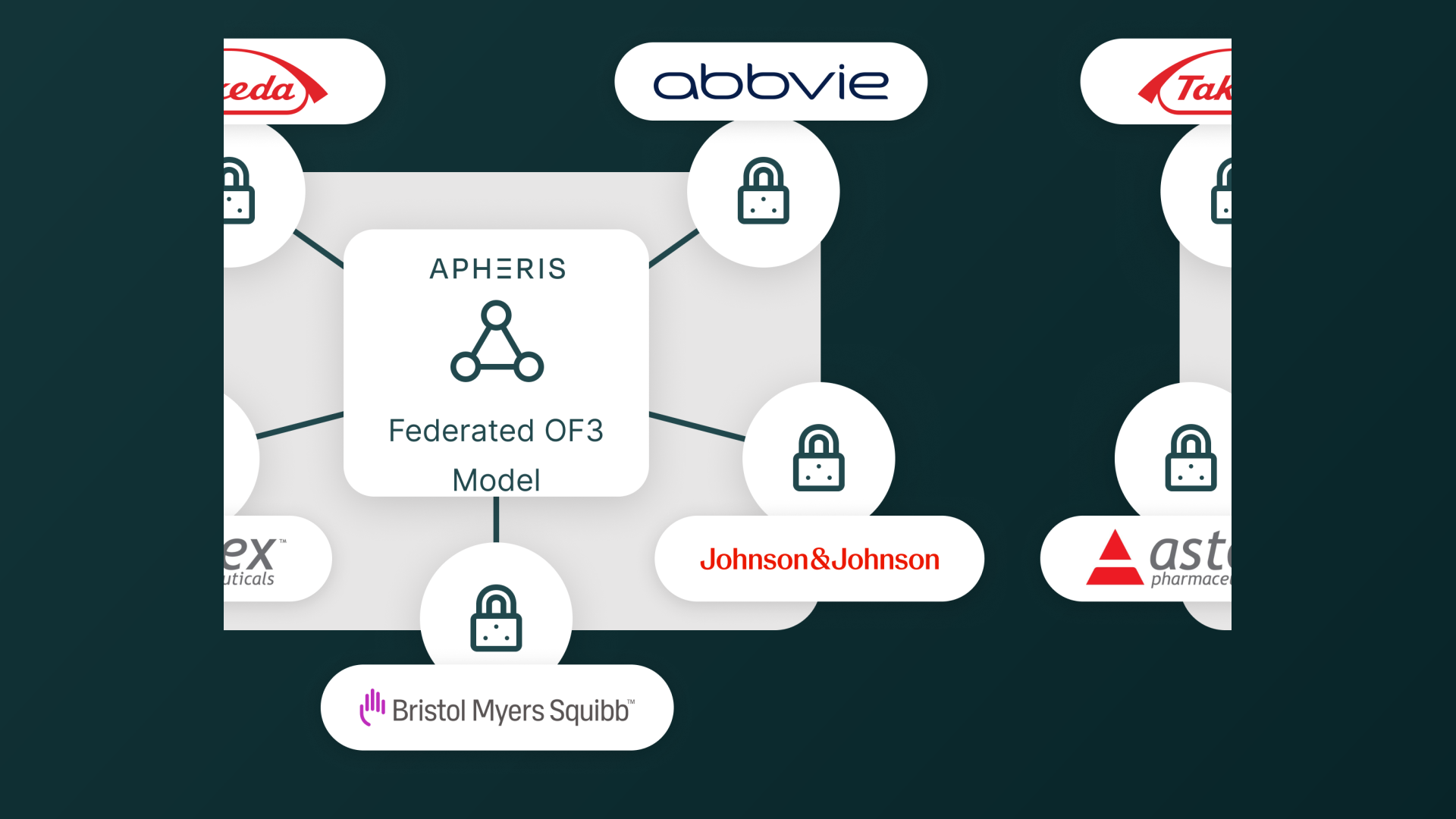
The AI Structural Biology (AISB) Network provides a mechanism for improving co-folding models using proprietary pharmaceutical data while keeping that data inside each participating organization.A recent example is the Federated OpenFold3 Initiative, where five pharmaceutical companies, AbbVie, Johnson & Johnson, Astex Pharmaceuticals, Bristol Myers Squibb, and Takeda, collaborated to fine-tune OpenFold3 across their internal structural datasets. Each partner contributed several thousand experimentally determined protein–small-molecule structures. Instead of sharing data, partners trained local model updates on their own datasets. These updates were then aggregated using privacy-preserving federated learning, producing a shared model checkpoint that captures signal across all participating datasets while ensuring that confidential structures never leave the originating organization.
The resulting federated OpenFold3 model showed stronger interface-focused performance metrics and a broader applicability domain than both the public OpenFold3 model and any single-party model trained on an individual dataset.For discovery teams, this approach addresses a fundamental limitation of structure prediction models: no single organization has enough structural data to train broadly generalizable models alone. Federated training allows models to learn from diverse structural datasets while preserving data ownership and intellectual property.Models emerging from AISB and other collaborative initiatives can be deployed locally through ApherisFold and evaluated and used within lead optimization workflows, where improved structural predictions support compound design and prioritization.

Federated OpenFold3 Initiative of the AISB Network
Structural predictions as part of compound prioritization
Structural predictions can guide the generation of compound design hypotheses, and can inform compound selection for synthesis through design filtration and prioritisation.When co-folding models are assessed for accuracy by internal benchmarking, adapted through fine-tuning, and predictions are scored and inspected by medicinal chemists within discovery workflows, they can become a key decision driver in lead optimization programs.When deployed well, co-folding models support faster iteration cycles and more informed compound selection during DMTA cycles, ultimately reducing the time and cost of drug discovery programs.
References