Federated network models
Trained across pharma partners
FOR NETWORK MEMBERS
Trained on proprietary data across an Apheris network, without any data leaving a partner.
APHERIS FOUNDRY
why foundry exists
Public structures and assays cover a narrow slice of chemistry. Your targets and scaffolds sit outside it. To make models work on your chemistry, you need to customize them on your data.
01
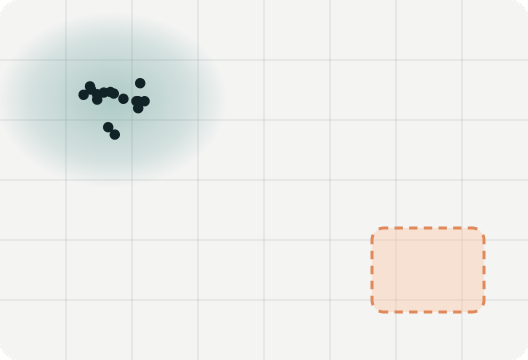
Public models
Trained on the PDB and published assays. Reliable only close to public chemistry.
02
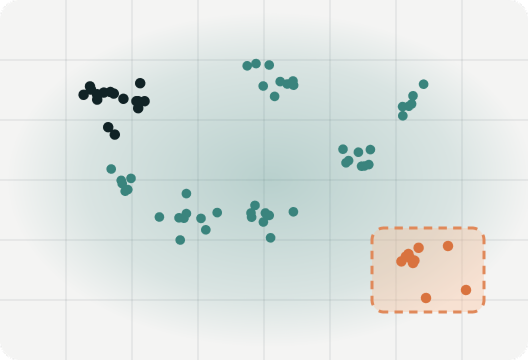
Federated models
Trained across pharma partners’ proprietary data, including your own. Results in a broader applicability domain.
03
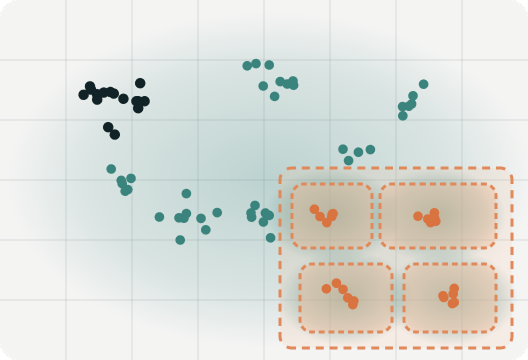
Fine-tuned on your programs
The federated model, fine-tuned further on each of your programs and checked against where you started.

Public data

Pharma partners’ proprietary data

Your proprietary data

Your program

Where the model is reliable
HOW IT WORKS
STEP 1
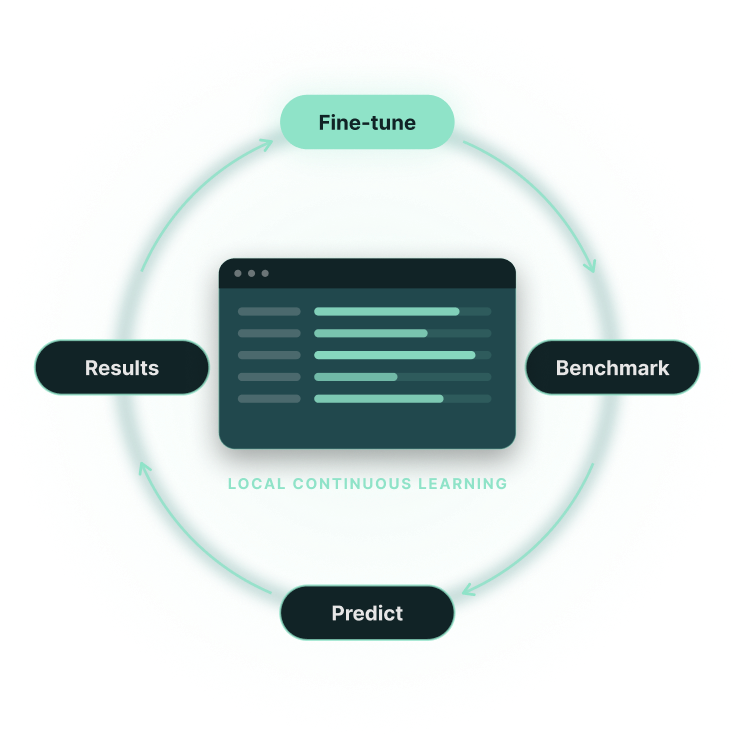
Benchmark and choose your starting point.
Benchmark open-source, partner or network models on your own data and start from the one that performs best on your targets.
STEP 2
Fine-tune the chosen model on your data.
Fine-tune models on your proprietary data, so they learn the chemistry and targets of your programs.
STEP 3
Run the fine-tuned model where your science happens.
Run single predictions or full workflows from your agents, the CLI or the interface, inside your own infrastructure.
Every result feeds back in, so the model keeps improving on your programs.
Built to fit your workflow
Use Foundry your way.
Start with our workflows, use the tasks you need, or combine with your own. Work with your agents, in your environment.
Fits your environment.
Orchestrate with Foundry Hub, or run tasks directly on your infrastructure.
MODELS
Start from the strongest model for your target.
Foundry is model-agnostic. Benchmark open-source, partner and network-trained models on your own data, fine-tune the one that performs, or bring your own.
Co-folding
OpenFold3 · Protenix
Structure prediction with templating. Fine-tune OpenFold3 on your own structures.
Binding affinity
ApherisAffinity
NEW · BUILT BY APHERIS
Our own affinity model: a geometry-aware head on OpenFold3-OpenBind that reads the co-folded binding pose and predicts affinity and binding probability.
De novo design
RFD4-Proteina
Designs binders, VHHs, antibodies and enzymes against protein, small-molecule or nucleic-acid targets, on your own GPUs.
ADMET
Prediction and fine-tuning
Predict ADMET properties and fine-tune the models on your own assay data.
Partner models
SandboxAQ · AQPotency
Models from partners, running in the same workflows as the rest of Foundry.
Bring your own model
Your models and code
Package your own models as tasks and plug them into the same workflows through compatible interfaces.
Federated network models
Trained across pharma partners
FOR NETWORK MEMBERS
Trained on proprietary data across an Apheris network, without any data leaving a partner.
Co-folding
Structure-based affinity prediction
Antibody-antigen ranking
Antibody developability
ADMET
BINDING AFFINITY
ApherisAffinity: our own affinity model, grounded in the binding pose.
ApherisAffinity is the binding affinity model we built at Apheris, now running on Foundry. It is a geometry-aware head on OpenFold3-OpenBind that reads the ligand atoms and nearby protein atoms in the co-folded complex, and predicts affinity (pKd) and binding probability.
Trained on poses that match the crystal structure
About 390,000 measured affinities, kept only where the predicted pose agrees with a validated PDB reference, plus synthetic negatives that disrupt the contacts binding depends on.
Ranks binding beyond molecular size
Larger molecules tend to score higher on affinity benchmarks. On OpenBind compound pairs matched for size, ApherisAffinity ranks 66% correctly, against 53% for Boltz-2 and 48% for molecular weight alone.
Responds to the binding site
When pocket contacts are disrupted by mutation, or the target is swapped, ApherisAffinity’s binding prediction falls to chance, as a model that reads the pocket should. Independent studies found Boltz-2 keeps much of its discrimination in the same tests.
Affinity ranking on the OpenBind benchmark
Spearman correlation across 494 compounds (higher is better)
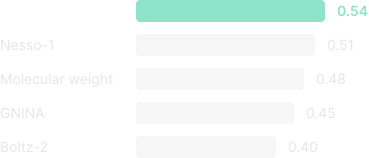
Source: Grounding ApherisAffinity predictions in binding structure
BLOG
Grounding ApherisAffinity predictions in binding structure
How the model is built and trained, and how it performs on public benchmarks.
ACCESS
Three ways to access Foundry.

Agents
Models and workflows ship with skills, so your agents can find, compose and launch workflows from the tools your teams already use.


Programmatic (CLI and API)
Integrate tasks and workflows into your existing DMTA tooling and pipelines through the Foundry Hub API.

Graphical interface
Launch selected workflows and review their results in the browser, without writing code.
SECURITY AND IP
Runs where your data is. Your IP stays protected.

Your queries never leave your environment.
Use Foundry with your local agents and LLM orchestration tools, and connect it to your local MSA server.

Your data is never exposed and always protected.
No other party ever sees your data. Models you train on it are fully yours.
Deploy Foundry in your own Kubernetes cluster or virtual machine, or, for teams that prefer no infrastructure, let Apheris host and manage it.
A neutral operator.
Apheris is a technology partner and network operator. We do not develop our own drug assets. We provide technology and services to enhance your drug programs.
WORKING WITH APHERIS
Our forward-deployed scientists work side by side with your computational chemists and antibody engineers: your team knows your drug programs best, and ours knows how to customize the models and get the most out of them. Together, we take a model from the first benchmark to predictions your team uses in design decisions.
DOCUMENTATION
Get to know Foundry before you start.
The public documentation gives your computational and platform teams an overview of Foundry.
Workflows and tasks
What each workflow does and how workflows build on tasks.
Access
How teams and agents work with Foundry through the CLI, API and browser interface.
Deployment
The deployment options and what Foundry needs from your infrastructure.
FOUNDRY IN PRACTICE
Case studies and announcements.
What our scientists have done with Foundry workflows on small, program-sized datasets.
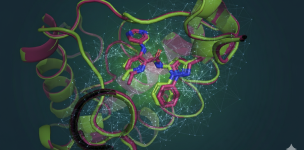
case study
Fine-tuning OpenFold3 on ten PDE10 structuresStructure fine-tuning on just ten structures improved predictions across 17 held-out PDE10 complexes.
case study
Fine-tuning the affinity head on a JAK2 macrocycle seriesFine-tuning the affinity head on 49 congeneric macrocycles improved ranking where the out-of-the-box model failed.
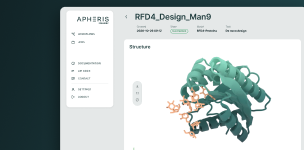
ANNOUNCEMENT
RFD4-Proteina is now on Foundry
The open de novo design model from NVIDIA and the Baker Lab at the Institute for Protein Design.
FAQ
Frequently asked questions about Apheris Foundry.
FIRST CONVERSATION
What happens when you reach out.
Julian Schönauer
Commercial fit, engagement model, next steps.

Neann Mathai
Scientific fit, benchmarking, what is realistic on your data.
Your first conversation is with Julian and Neann, on commercial fit, and on the science.
1
Understand your situation.
We talk through your programs, your data, and where your current models fail.
2
Find where we can add value.
Together we identify the workflow or decision where a customized model would move the needle, and what improvement is realistic.
3
Scope a pilot.
GET STARTED
The fastest way to see value is on an active program. Tell us what you are working on, and we will come back with a focused pilot: one question, a measurable target, and a path to scale. You will hear back from Julian and Neann directly.
