
The power of strong protein-ligand co-folding models is not just limited to creating useful visualizations or building high-level hypotheses, but also comes from the ability to create predictions which are reliable enough to prioritize which compounds you take forward into synthesis, saving time and resources.That’s why I’ve been looking closely at retrospective analysis of newly published ligand-bound structures. They offer the chance to ask a simple, practical question: would a co-folding prediction have supported the right compound design decisions? A recent Journal of Medicinal Chemistry study on selective S. aureus TrmD inhibitors provides exactly that kind of test case. The study is a particularly interesting as a benchmark because it reports both structure–activity relationships and publishes the first ligand-bound crystal structures, giving me experimental ground truths which were published after the current OpenFold3 training set cutoff.This TrmD example is also part of a broader effort I’m currently working on: collecting concrete co-folding predictions that work well, alongside cases where they fail or become ambiguous. The goal is to build practical guidance for medicinal chemists, when co-folding results can be trusted out-of-the-box, when additional fine-tuning is likely needed, and where collaborative or federated training on industry data could meaningfully improve reliability.
A well-defined medicinal chemistry problem
In their paper, the authors describe a scaffold hop from thieno-pyrimidone based TrmD inhibitors (previously reported to inhibit H. influenzae TrmD) to a pyrrolo-pyrimidone series that show improved binding affinity against S. aureus TrmD.Using a direct-to-biology approach, they generated a nanoscale CuAAC library of 320 pyrrolo-pyrimidone derived triazoles with diverse physicochemical properties. From this set, five hit compounds were resynthesised and showed confirmed dissociation constants ranging from 0.7 to 2.5 µM, a clear improvement over the original thieno-pyrimidone series.Crucially, the study also reports the first ligand-bound crystal structures of S. aureus TrmD, including thieno-pyrimidone 2 and the most potent hit, 8h (PDB: 9SDV and 9SDW respectively). These structures provide an excellent opportunity to ask a very practical question: would co-folding have predicted the relevant binding mode and key interactions before the compounds were made and tested?
Testing the case in ApherisFold Lite
To explore this, we used ApherisFold Lite, the browser-based version of ApherisFold, to generate protein–ligand co-folding predictions with OpenFold3.Starting from the apo S. aureus TrmD structure (PDB: 3KY7), we folded the protein together with the SMILES representations of compounds 2 and 8h, as well as a small set of inactive analogues from the same chemical series.
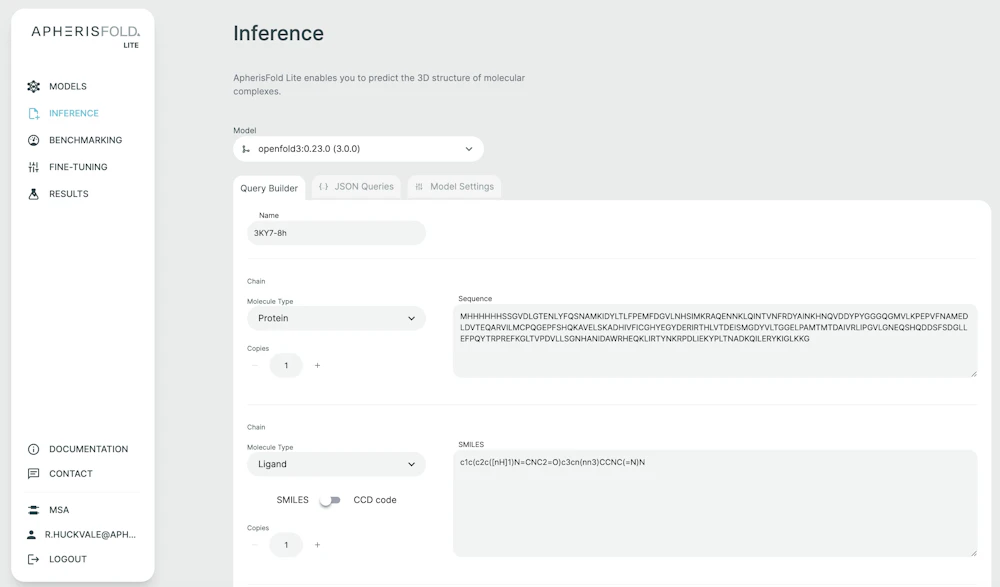
ApherisFold Lite Inference - Input
For both active compounds, the predicted complexes showed good agreement with the experimental structures. When compared to the crystallographic poses, ligand RMSDs were below 2 Å, and ligand–protein LDDT values were around 0.8. Importantly, the models recovered the interaction between the ligand and Glu132 at the top of the binding pocket that appears to be key for affinity in this series.When the same workflow was applied to inactive compounds, the predictions did not place the ligands in geometries that could form this Glu132 interaction. While this does not constitute a quantitative activity prediction, it is consistent with the reported SAR and provides a plausible structural rationale for the lack of binding.

ApherisFold result Interface
Where co-folding helps and where it doesn’t
This example highlights a realistic and useful role for protein–ligand co-folding in medicinal chemistry projects.Co-folding is not a replacement for crystallography, nor does it eliminate the need for experimental validation. However, it can be a fast way to sanity-check whether a proposed series-defining interaction is structurally plausible, and to filter or prioritize designs before committing to larger synthesis campaigns or structural biology efforts.In this TrmD case, the ability to quickly assess whether compounds are predicted to engage Glu132 could have helped prioritise within a large triazole library and informed the design of follow-up analogues, even without access to experimental structures.The key is using co-folding thoughtfully: understanding what signals to trust, which interactions matter for the series, and where the model’s confidence breaks down.
Trying this yourself with ApherisFold Lite
ApherisFold Lite was built to make exactly this type of evaluation easy. It is a publicly hosted, low-friction way to explore how OpenFold3 behaves on real protein–ligand problems, without setting up GPUs or deploying infrastructure.With ApherisFold Lite, you can:
- Open the co-folding interface directly in your browser
- Run OpenFold3 protein–ligand predictions
- Inspect and compare predicted complexes using an interactive 3D viewer
If you want to test how co-folding performs on your own targets or chemical series before deploying a full local setup, you can try ApherisFold Lite for free here: https://try.fold.apheris.net/terms-of-use
References