Core ADMET Network Benefits
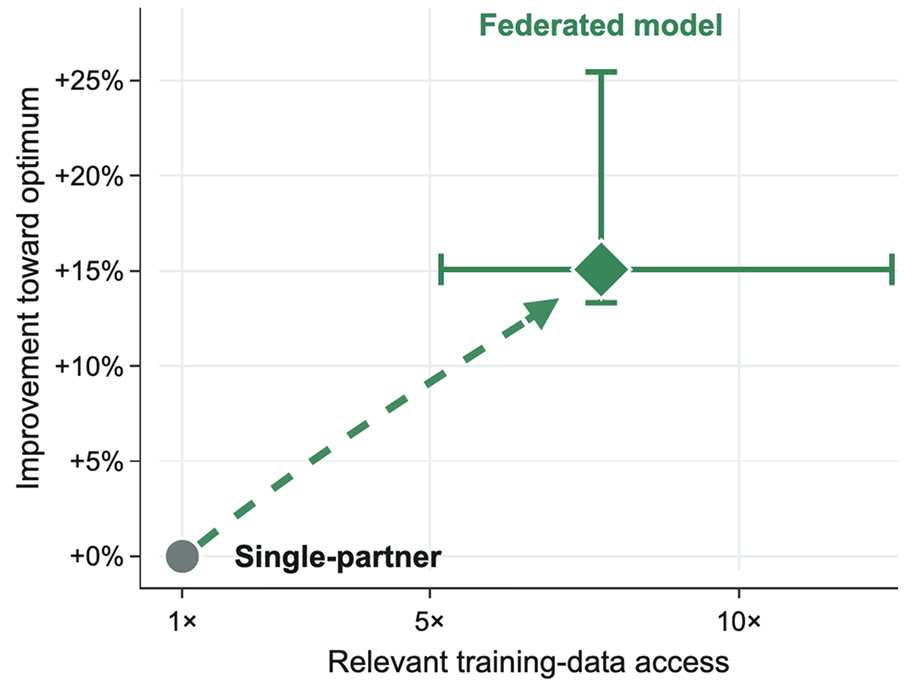
Broader applicability domain
Leverage complementary industrial ADMET data beyond your own assays.
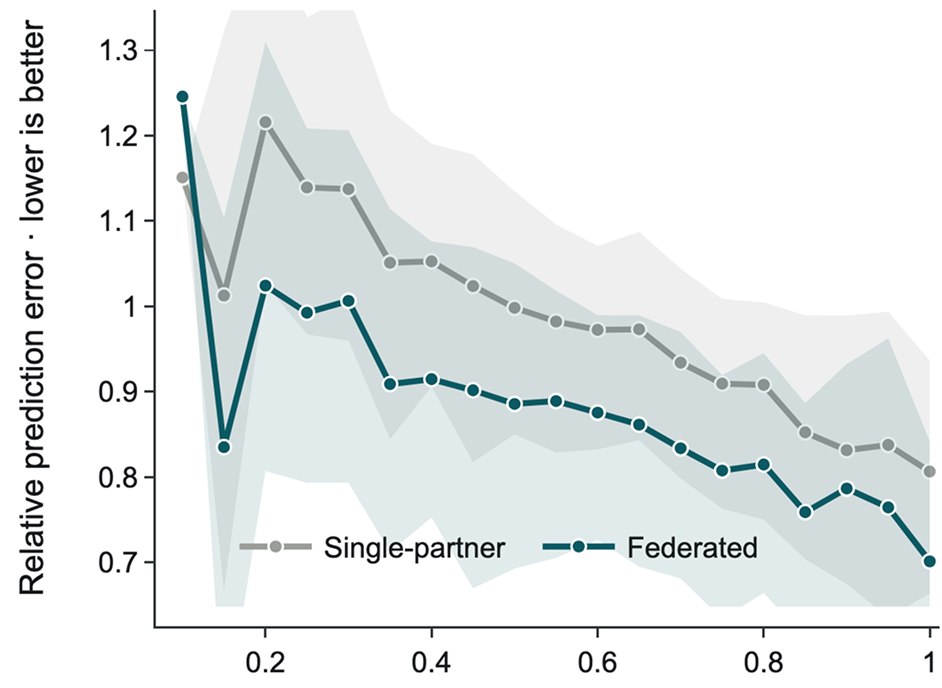
Earlier signal on ADMET risk
Navigate from poor profiles or drop weak series earlier using better-calibrated ADMET predictions and uncertainty estimates on novel chemistry.
Faster, more productive DMTA cycles
Design more informative batches and use experimental capacity better in DMTA cycles.
To build trustworthy ADMET models for novel chemistry:
Participate in the Federated ADMET Network
For leaders in preclinical development, ADMET modelling, and discovery data science: You train a shared, federated molecular foundation model across proprietary pharma datasets, without moving raw structures, fingerprints, or assay tables outside your firewall. The result is not only stronger ADMET predictors today, but a reusable molecular representation you can further fine-tune for future internal endpoints and generative design workflows.
Your results in the first months of participation
Improved predictions on novel scaffolds
ADMET predictions that behave more reliably on novel scaffolds and less-characterized regions of chemical space.
Baseline model that can be fine-tuned
A strong baseline model trained across diverse proprietary discovery datasets, fine-tuned on your own assays and chemotypes.
Models that better support early decisions
ADMET modelling that helps bring failures forward and supports faster, better-explained DMTA and portfolio decisions, without moving raw structures or compromising IP and data governance.
How the federated ADMET model is structured
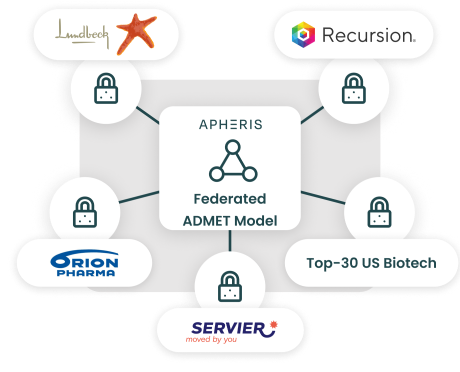
The ADMET Network uses a head–trunk architecture that enables learning from broader data while keeping endpoints and labels local.
The ADMET Network uses a head–trunk architecture: a shared trunk learns a molecular foundation model across partners’ proprietary discovery datasets, while partner-specific heads are trained only on local ADMET endpoints. This lets the model benefit from diverse industrial chemistry and assays, improving generalization to novel scaffolds. Only model weight updates are shared; all raw structures and assay tables remain inside each company.
The Apheris team leading the ADMET Network
Why we are building the Federated ADMET Network
You already use ADMET models in early discovery, but performance still drops when you move into novel scaffolds and low-coverage regions of chemical space? Most teams now hit the point where model architecture is not the bottleneck anymore – data is your true differentiator. What you are missing is exposure to more diverse ADMET data, especially on novel scaffolds and low-coverage regions of chemical space. At the same time, that same data is also core IP that cannot simply be shared or pooled across companies. The ADMET Network is our answer to this gap. It gives leaders in preclinical development, ADMET modelling, and discovery data science a way to train stronger models collaboratively while all raw data and IP stays local. Your Federated ADMET Network team
Get the Federated ADMET Network overview
Download the detailed overview to dive deeper into how the network works across partners.
Learning setup and workflow How the end-to-end federated training process works, from partner data preparation to joint model training and inference.
Initial endpoints and data requirements The first ADMET endpoints in scope and what is expected in terms of format and volume per partner.
Trusted head–trunk architecture How a shared trunk (molecular representation) and partner-specific heads let the model learn from cross-partner diversity while your endpoints and labels stay local.
Further reading on federated ADMET modelling
FAQ section
Frequently asked questions about the Federated ADMET Network
Want to explore joining the ADMET Network?
Speak with us about fit, endpoints, and timelines for your organization.