
Build your Federated RWE Network
Use patient data without centralizing it
Access multi-modal data
Run GDPR-aligned collaborations
Reduce per-study approvals and setup
With traditional approaches RWE slows down because patient data cannot be used across sites
Common challenges in today’s RWE setups, addressed by federated RWE networks:

Patient data sits across hospitals and partners
The data needed for multi-site studies remains inside each site environment.

Strict data protection rules limit cross-site data use
GDPR, site governance, and contractual constraints restrict how studies can run across sites.

Every study becomes a new coordination effort
Approvals, legal review, and technical setup often need to be repeated site by site. As a result, site relationships exist, but cannot be turned into scalable RWE studies.
What your RWE network makes possible

Run studies across sites with less setup
Deploy infrastructure and governance once per collaboration, then avoid repeating approvals, legal review, and technical onboarding for every new study.

Work with broader clinical data under site control
Run analyses across hospital-held patient data while each site keeps control of its own data, policies, and environment.

Go beyond predefined datasets
Traditional agreements often limit researchers to predefined extracts or narrow study scopes. Federated computing makes it possible to run analysis directly on site-held data for deeper clinical insight.
Move from one-off studies to a reusable RWE network.
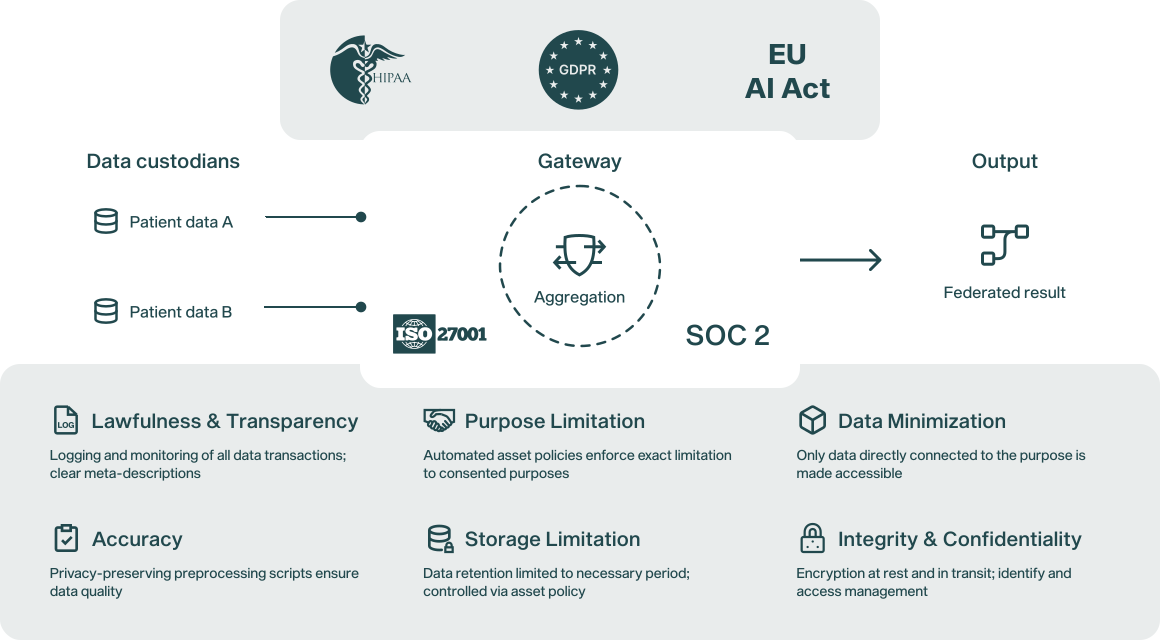
Work with patient data under GDPR and HIPAA and site governance

Work with patient data under GDPR
Patient data remains within each site environment, allowing studies to run across institutions without transferring or centralizing sensitive data.

Simplify ethics board approvals
By addressing privacy upfront through federated architecture and deploying governance once per collaboration, teams can reduce repeated study approvals, contracting effort, and stakeholder coordination.

Run analysis on granular data
Instead of relying on predefined extracts or aggregated datasets, teams can run analyses directly on site-held data for deeper and more flexible evidence generation.
RWE Network case study
Our federated computing product powers multi-site data networks for real-world clinical research. One example is a neuroscience data network built to study disease progression using real-world patient data. The network connects data from multiple hospitals across more than 50,000 patients, including EHR, imaging, and other patient-level data. Using our federated computing product, pharma teams run statistical analyses, machine learning, and imaging AI directly at each site, without moving patient-level data. This enables cross-site studies on real-world patient data while meeting strict data protection and governance requirements.
Working in partnership with Apheris adds new data analytics capabilities within the TriNetX industry leading global federated real‑world data network. This makes it possible to support a broader range of global advanced analytics and machine learning workflows on site-held patient data while maintaining privacy-preserving computational governance. Additionally, our partners can connect their own data to the TriNetX data network without moving any data.
FAQ section
Frequently asked questions about Federated RWE Networks
| Question | Answer |
|---|---|
| How does this work under GDPR, HIPAA and other data protection laws? | Patient data remains at each site and is never centralized. Only approved computations are executed locally, and only controlled outputs are shared. This allows collaboration across institutions while aligning with GDPR and site governance requirements. |
| Do sites need to move or share patient data? | No. Data stays within each hospital or partner environment. Analysis runs where the data resides, so there is no need to transfer or pool sensitive data. |
| How is this different from data platforms or TREs? | Traditional platforms rely on centralizing or aggregating data. A federated network runs analysis across sites, enabling access to raw data without moving it. |
| How much effort is required to set up a network? | The infrastructure and governance are deployed once per collaboration. After that, new studies can run without repeating approvals, contracts, and technical setup for each site. |
| What types of analyses can be run? | Statistical analysis, machine learning and AI workflows can be executed across sites, including work on multi-modal data such as EHR, imaging, registries, and genomics datasets. |
| How do you achieve a smooth experience and facilitate approvals for clinical sites? | Privacy and governance are addressed upfront through the federated architecture, with clear rules on what analyses can run on which data. Infrastructure and governance are deployed once per collaboration, reducing the need for repeated approvals and setup for each study. Sites keep control of their data, which simplifies participation and reduces workload across clinical, IT, and legal teams. |
Interested in building your RWE Network?
Speak with us about your setting.