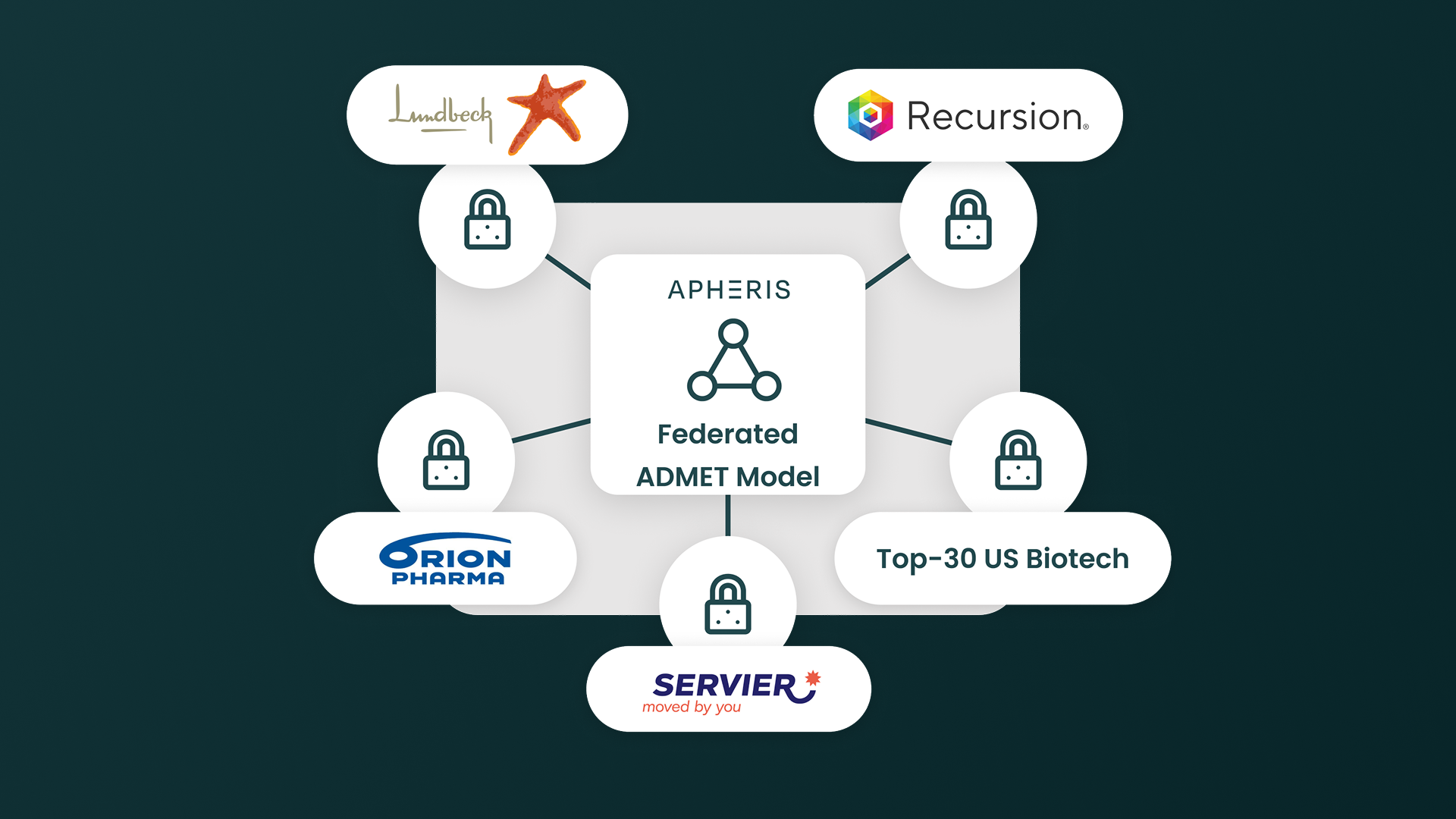
BERLIN, Germany, Feb. 25, 2026 – Apheris GmbH today announced the launch of the ADMET Network, a federated data network designed for pharmaceutical companies to collaboratively train models for absorption, distribution, metabolism, excretion, and toxicity (ADMET) predictions without sharing proprietary data. The ADMET Network launches with Lundbeck, Orion Pharma, Recursion, and Servier, among other founding members. The network is structured to allow additional pharmaceutical companies to join over time.
ADMET modelling remains one of the most critical and challenging areas of drug discovery, accounting for an estimated 40–45% of clinical attrition. Developing accurate ADMET prediction models requires access to high-quality data spanning a broad and diverse chemical space. In practice, most models are trained on a combination of public datasets and proprietary data from individual organizations, which often results in constrained chemical coverage and limited generalizability. As a result, many ADMET models fall short in early-stage drug discovery, where novel chemotypes are common and predictive reliability is needed.
The ADMET Network was created to address these limitations by enabling pharmaceutical companies to collaboratively train robust ADMET models with an expanded applicability domain that better reflect industrial discovery needs. By bringing together highly diverse proprietary ADMET datasets across members, it is assembling one of the largest distributed ADMET data foundations in the industry. As new members and data are added, chemical coverage and model applicability will expand over time. Initially focused on small molecules, the network is designed to expand to additional drug modalities, including PROTACs, peptides, and macrocycles. Federated models are trained across the network and fine-tuned locally on each member’s proprietary data, with resulting models remaining private to each participant. Apheris provides the end-to-end technical and scientific framework as well as its proprietary federated computing technology, enabling collaborative model development while each participant retains full control over data and IP. Model development, benchmarking, and delivery are centrally coordinated to ensure scientific rigor, comparability, and fair participation across members.
“In therapeutic areas such as CNS, early discovery decisions are shaped by complex ADMET considerations,” said Paul Kilburn, Senior Director, Medicinal Chemistry and Translational DMPK at Lundbeck. “The ADMET Network enables more confident decision-making by improving how models generalize to novel chemistry, beyond what can be learned from a single organization’s experience alone.”
“At Orion Pharma, we have invested heavily in applying ML/AI models across our discovery programs,” said Leena Otsomaa, Vice President, Medicine Design, at Orion Pharma. “We see collaborative model development as becoming a baseline for the industry, where shared learning across diverse datasets improves general performance, and program-specific fine-tuning then allows models to be tailored to the needs of individual drug programs.”
Other founding members emphasized the role of industry-scale collaboration in addressing persistent bottlenecks in early drug discovery. “At Recursion, we apply AI end-to-end across drug discovery and development, with a deliberate focus on the bottlenecks in R&D where failure rates are highest,” said Najat Khan, CEO and President of Recursion. “ADMET remains one of the most persistent challenges in translating novel discoveries into successful medicines. By participating in the ADMET Network, we can materially improve the reliability of our early predictions by learning from a broader set of industry data—without compromising data ownership or IP. It’s a powerful example of how industry collaboration can accelerate innovation with real impact, helping deliver more medicines that matter.”
“At Servier, ADMET modelling is deeply embedded in our early discovery workflows, informing compound selection across multiple endpoints,” said Christophe Thurieau, Executive Director Servier Research. “With a strong group of founding members and additional partners joining over time, the ADMET Network provides an opportunity to further strengthen these models, both in terms of predictive accuracy and applicability domain, while fully preserving data ownership.”
Apheris highlighted how the ADMET Network builds on its experience coordinating large-scale, privacy-preserving collaborations across pharmaceutical companies. “Apheris has earned the trust of pharmaceutical companies through large-scale collaborative networks, including the AI Structural Biology (AISB) Network, and we’re now extending that experience to ADMET,” said Robin Röhm, Co-founder and CEO of Apheris. “With the ADMET Network, our focus is on delivering models with predictive reliability, allowing chemists to place greater confidence in ADMET predictions when evaluating novel compounds in discovery programs.”
About Apheris
Apheris builds federated data networks for drug discovery. Network members provide privacy-preserving access to their data and, in return, get models with higher performance and a broader applicability domain. Apheris provides the federated learning infrastructure and centrally coordinates scientific, legal, and operational aspects. Apheris hosts the largest industry data networks across multiple drug discovery domains, including co-folding (e.g., the AI Structural Biology Network), ADMET, and antibody developability.
References