Federated Training Dramatically Improves the Accuracy of Protein-Ligand Co-folding on Private Pharma Structures
Avelino Javer¹, Nicolas Gautier¹, Benedict W. J. Irwin¹, Alwin Bucher¹, José-Tomás (JT) Prieto¹, Inken Hagestedt¹, Ruda Porto Filgueiras¹, Mees Hendriks¹, Lewis Mervin¹, Mark Sharpley¹, Ian Hales¹, Robin Röhm¹, Sreeja Kutti Kandy², Frank Oellien², John Karanicolas², Maria Kadukova3, Lucian Chan3, Carl Poelking3, Paul Mortenson3, Chris Murray3, Matt Pokross4, Veerabahu Shanmugasundaram4, Payal Sheth4, José Carlos Gómez Tamayo5, Gary Tresadern5, Edward King6, Prashanth Vishwanath6, Lukas Jarosch7, Vinay Swamy7, Mohammed AlQuraishi7
¹Apheris ²AbbVie 3Astex Pharmaceuticals 4Bristol Myers Squibb, 5Johnson & Johnson, 6Takeda, 7AlQuraishi Lab, Columbia University
Public co-folding models are trained on public data, where only a small fraction of structures are drug-relevant, systematically under-representing the regime where structure-based drug design operates. The structures that carry the richest signal for drug-discovery models, dense medicinal-chemistry series around real targets, sit inside individual pharmaceutical companies, behind legal and commercial walls that keep them from being pooled.
Federated learning offers a way around this. A shared model is trained across private datasets without the underlying structures ever leaving their owners. Additional privacy safeguards ensure no IP-sensitive information is exposed. Federation is not new to drug discovery. Earlier large-scale pharma federation efforts proved that cross-company training was feasible but delivered only modest gains in model performance. Making federation deliver a meaningful improvement is the problem Apheris set out to solve.
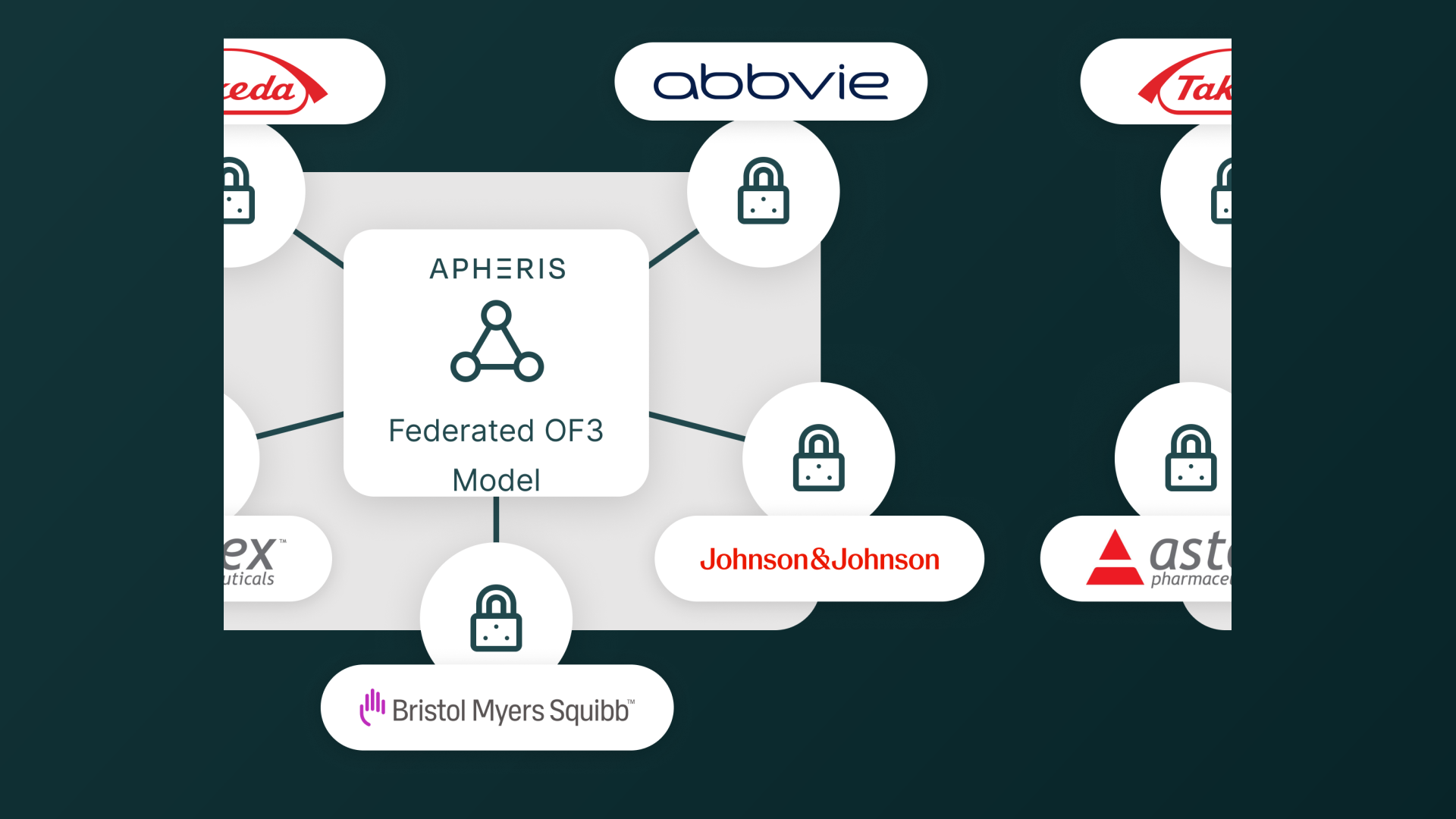
Federated learning is the approach behind the AI Structural Biology (AISB) Network, an industry-led collaboration formed to advance AI for drug discovery, powered by Apheris.
In their Federated OpenFold3 Initiative, participating AISB Network members asked whether OpenFold3 Preview 2, a publicly available co-folding model, fine-tuned jointly across their private structures, would predict protein-ligand complexes more accurately than public models, or than any model a single company could fine-tune on its own data alone.
The answer is yes.
The resulting federated model, which we call AISB-1-Fed, significantly raised the share of high-quality predictions from 36% to 52%, outperforming both public models and any model fine-tuned on a single partner's data alone. To our knowledge, this is the first clear demonstration that federated training delivers a step-change in co-folding accuracy, the start of a new era for federated drug discovery.
Run in collaboration with the AlQuraishi Lab at Columbia University, the developers of OpenFold3, AbbVie, Astex, Bristol Myers Squibb, Johnson & Johnson, and Takeda each fine-tuned OpenFold3 Preview2 locally on their own structures, with model parameters periodically aggregated through Apheris’ federated computing product. In total, the training data spanned more than 20,000 experimentally determined structures from active drug-discovery programs. That roughly triples the drug-relevant protein-ligand data available for training, forming the most diverse such dataset assembled in drug discovery to date. By necessity, the underlying structures and the trained model weights remain private to the participating companies; what we are making public are the aggregate results.
Main result
AISB-1-Fed substantially improves over OpenFold3 Preview 2 (OF3p2), the foundation model used for federation, and over all reference models evaluated on this private benchmark.
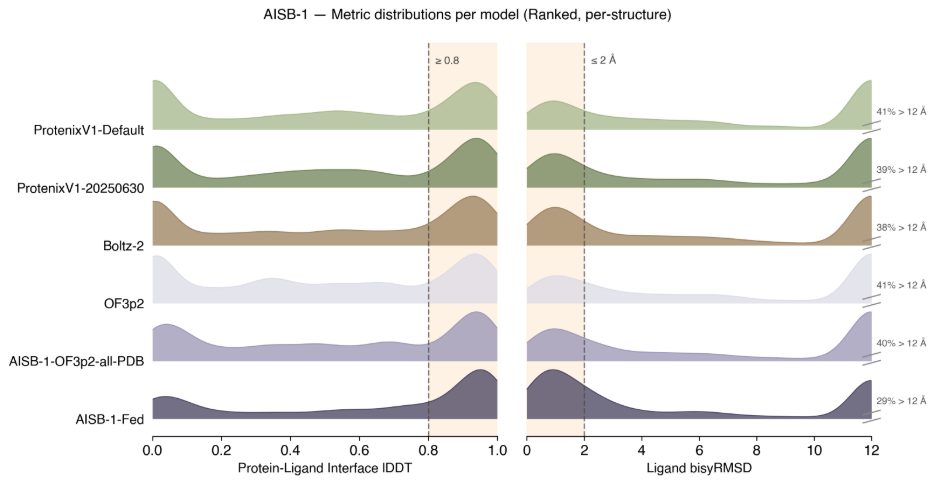
AISB-1-Fed is OF3p2 after federated fine-tuning on the five partners' roughly 20,000 private structures, together with public PDB data released up to November 2025. To separate the effect of the private data from that of the additional newer public data, the network also built a public-only baseline, AISB-1-OF3p2-all-PDB, by training OF3p2 on all available public PDB but no private structures. As the graphic shows, AISB-1-Fed clearly outperforms this baseline, so it is the private structures, that drive the improvement.
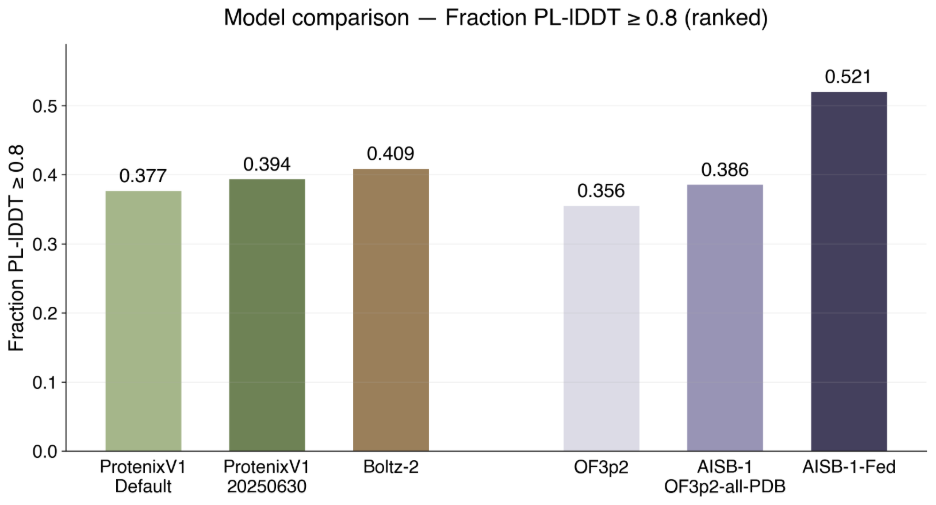
We report protein-ligand interface lDDT (PL-lDDT) for local interface quality and ligand bisyRMSD for pose accuracy.
AISB-1-Fed reaches 52.1% of structures with PL-lDDT ≥ 0.8, compared with 35.6% for OF3p2: a +16.5 percentage point gain (+46% relative). For ligand pose accuracy, it reaches 46.8% with bisyRMSD ≤ 2 Å, compared with 28.9%: a +17.9 percentage point gain (+62% relative).
Against the strongest public reference model on this benchmark (Boltz-2), AISB-1-Fed leads by approximately 11 percentage points on both metrics.
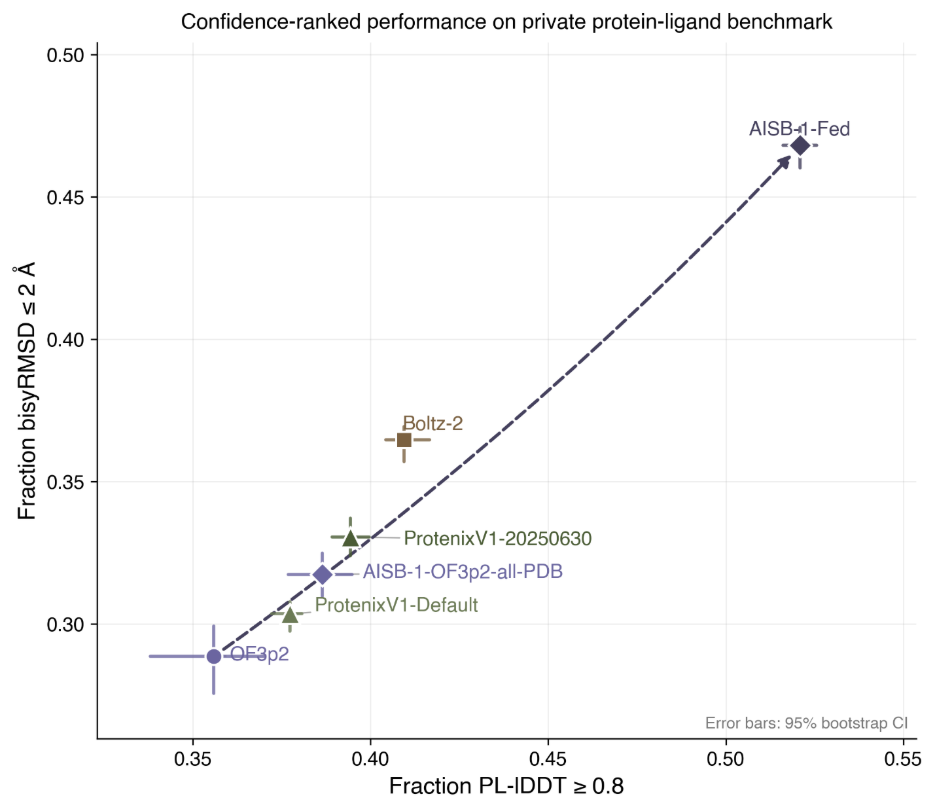
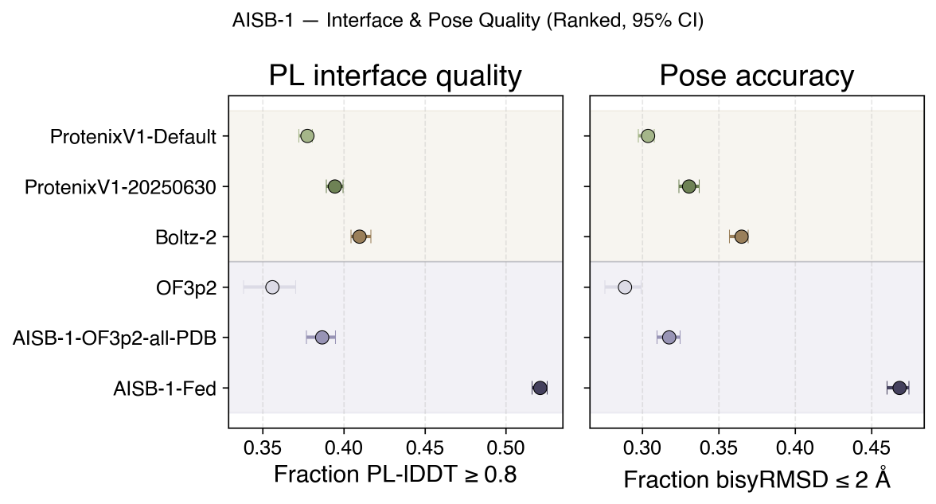
The two metrics are complementary. bisyRMSD focuses on absolute ligand placement, while PL-lDDT additionally captures interfacial interactions and pocket geometry. AISB-1-Fed improves both simultaneously, which makes the result more robust than an improvement on either metric alone.
Evaluation setup
We evaluated models on private evaluation structures from five pharmaceutical partners. After keeping only evaluation structures with successful predictions and metric calculations for all compared models and checkpoints, this gives 1,056 private evaluation structures across five datasets.
Each partner held out 5% of its private structures for evaluation. The split was made at the project level, with all structures from a given medicinal-chemistry project assigned entirely to either training or evaluation. Partners were also asked to select evaluation projects that were unlikely to appear in any other partner's training data. Together, these steps reduce the chance that evaluation structures are overly similar to training structures, whether from the same partner or from another. The five evaluation sets were pooled and treated as a single benchmark; no partner-level breakdown is shown without explicit partner approval.
Training was run to a pre-specified compute budget, and the final checkpoint was reported.
At a glance
- 20,167 private structures for training and a 1,056 held-out set for validation from five pharmaceutical partners
- Target/project-level split within each partner; pooled across partners for reporting
- Ranked sample selection using each model's native confidence score
- Primary metrics: fraction PL-lDDT ≥ 0.8 and fraction bisyRMSD ≤ 2 Å
- Aggregate reporting only; no partner-level disclosure without approval
Reference models. We compare against Boltz-2 and two ProtenixV1 checkpoints as external baselines, against OF3p2 as our starting-point reference, and against AISB-1-OF3p2-all-PDB as an internal control:
- OF3p2 (technical report): the base model that AISB-1-Fed was fine-tuned from.
- AISB-1-OF3p2-all-PDB: OF3p2 fine-tuned within the AISB Network on public PDB only, with a later cutoff (2025-11-19) matching Boltz-2 and ProtenixV1-20250630. A conservative control isolating the effect of updated public data from the private pharmaceutical structures.
- Boltz-2 (preprint): a co-folding model that jointly predicts complex structure and binding affinity.
- ProtenixV1 (preprint): ByteDance's co-folding model. We include ProtenixV1-Default (data cutoff aligned to AlphaFold3's original cutoff) and ProtenixV1-20250630 (extended cutoff for real-world use).
All reference models were evaluated on the same 1,056 private structures with the same metric pipeline.
Sample selection: Each structure was predicted with 5 diffusion samples across 5 seeds (25 predictions per structure). For each model, the best prediction is selected using the model's own native ranking score, specifically the confidence heuristic it exposes for choosing among multiple generated structures. For OF3p2, AISB-1-Fed, and ProtenixV1, this is a composite score weighting interface confidence (ipTM), overall alignment confidence (pTM), and penalties for disorder and clashes. For Boltz-2, it is a weighted average of complex pLDDT and interface confidence.
Thresholded fractions: PL-interface lDDT is bimodal on this benchmark. Roughly 28% of per-structure values fall below 0.2 (failures) and another 28% above 0.9 (near-perfect), with the middle largely empty. BisyRMSD has a long tail, with 29–41% of structures exceeding 12 Å depending on model. Means land in regions of the distribution that few structures actually inhabit. Thresholded fractions better answer the question of how often the model produces a useful prediction.
- Fraction PL-lDDT ≥ 0.8: a widely used marker of high-confidence interface quality
- Fraction bisyRMSD ≤ 2 Å: the conventional threshold for a correctly docked ligand pose
Why private pharmaceutical data helps
The result is consistent with private pharmaceutical structures carrying a learning signal that public data does not fully cover. Public databases hold very few dense series of related compounds medicinal-chemistry series around real therapeutic targets. Since the original AlphaFold3 cutoff, the PDB has grown by roughly 70,000 structures, but almost all are cofactors, metabolites, ions, and crystallographic additives rather than drug-like compounds. Only about 10,600 public structures contain an approved or investigational drug, and only about 3,000 of those are new since that cutoff.
The private structures contributed to AISB-1-Fed are all drug-discovery compounds, the very data the public record lacks.
Protein-protein interface quality
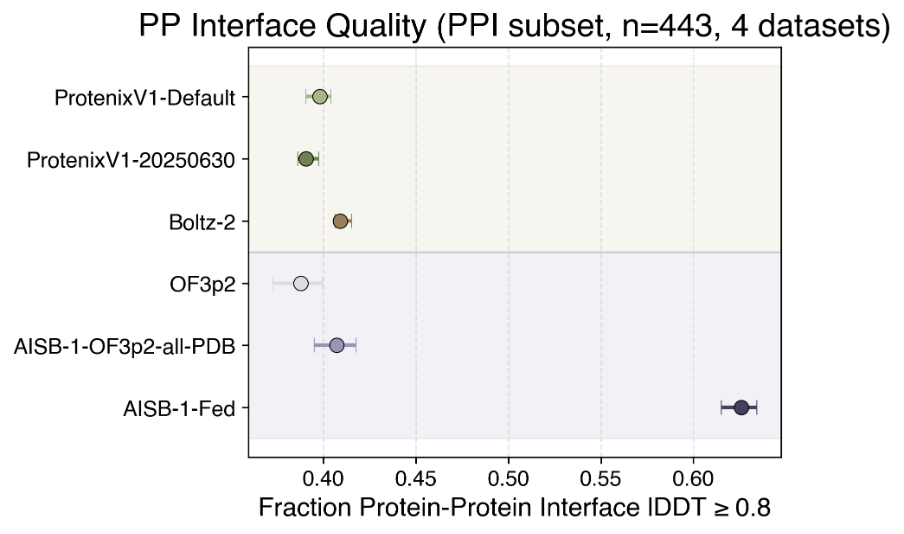
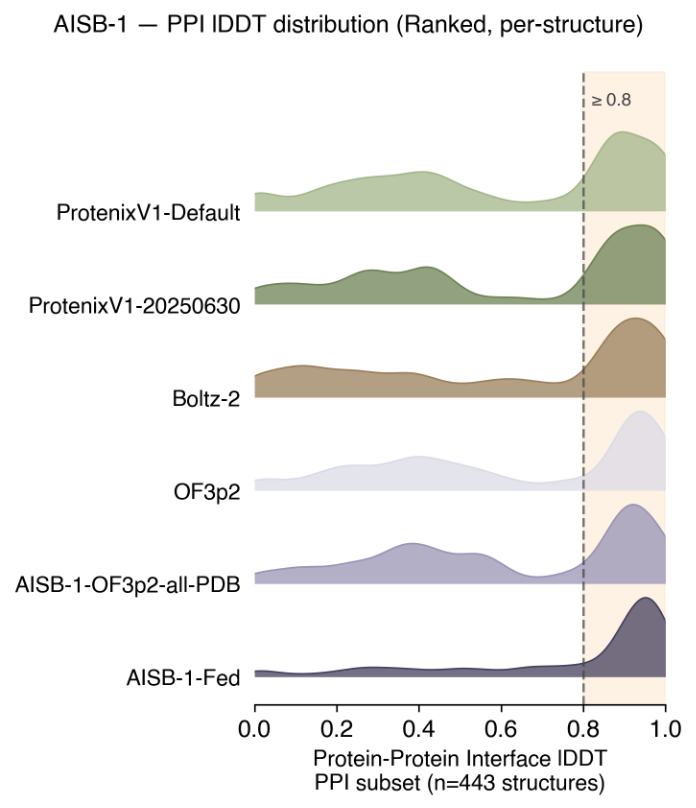
The Federated OpenFold3 Initiative was structured to improve protein-ligand co-folding; small molecule binding was the explicit target. We did not optimize for protein-protein interface (PPI) quality. Yet the PPI metric improved substantially as a by-product.
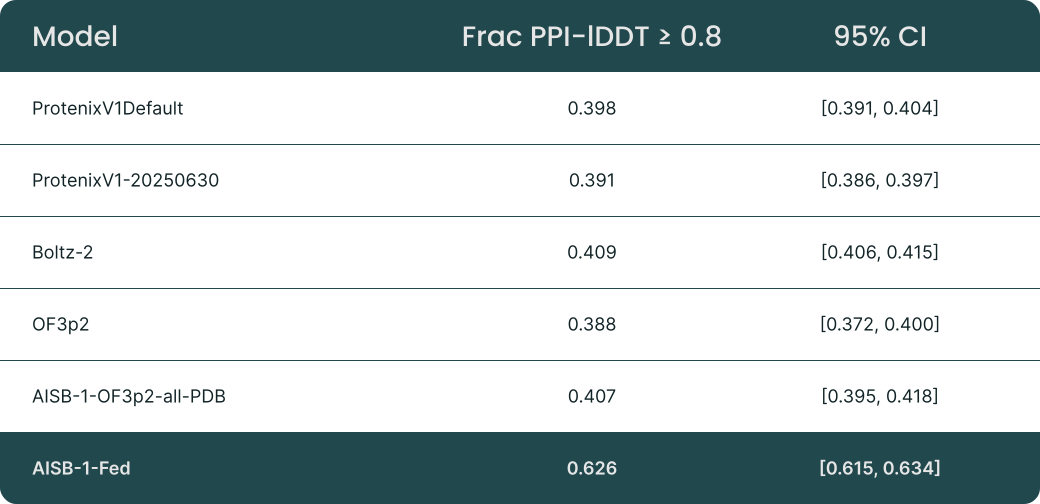
Many protein-ligand complexes in this benchmark involve multimeric protein assemblies with biologically relevant protein-protein interfaces. For the 443 structures with PPI annotations, we additionally report protein-protein interface lDDT (PPI-lDDT).
How the AISB-1-Fed model was trained
The AISB Network’s philosophy is to keep the federated algorithms simple, make the data interface consistent, and evaluate under realistic operational constraints. This approach has been validated in earlier federated experiments. It starts from OF3p2 and uses a 95/5 train/validation split of private structures. Training was accelerated using NVIDIA cuEquivariance kernels and distributed across multiple P5 instances powered by AWS EC2.
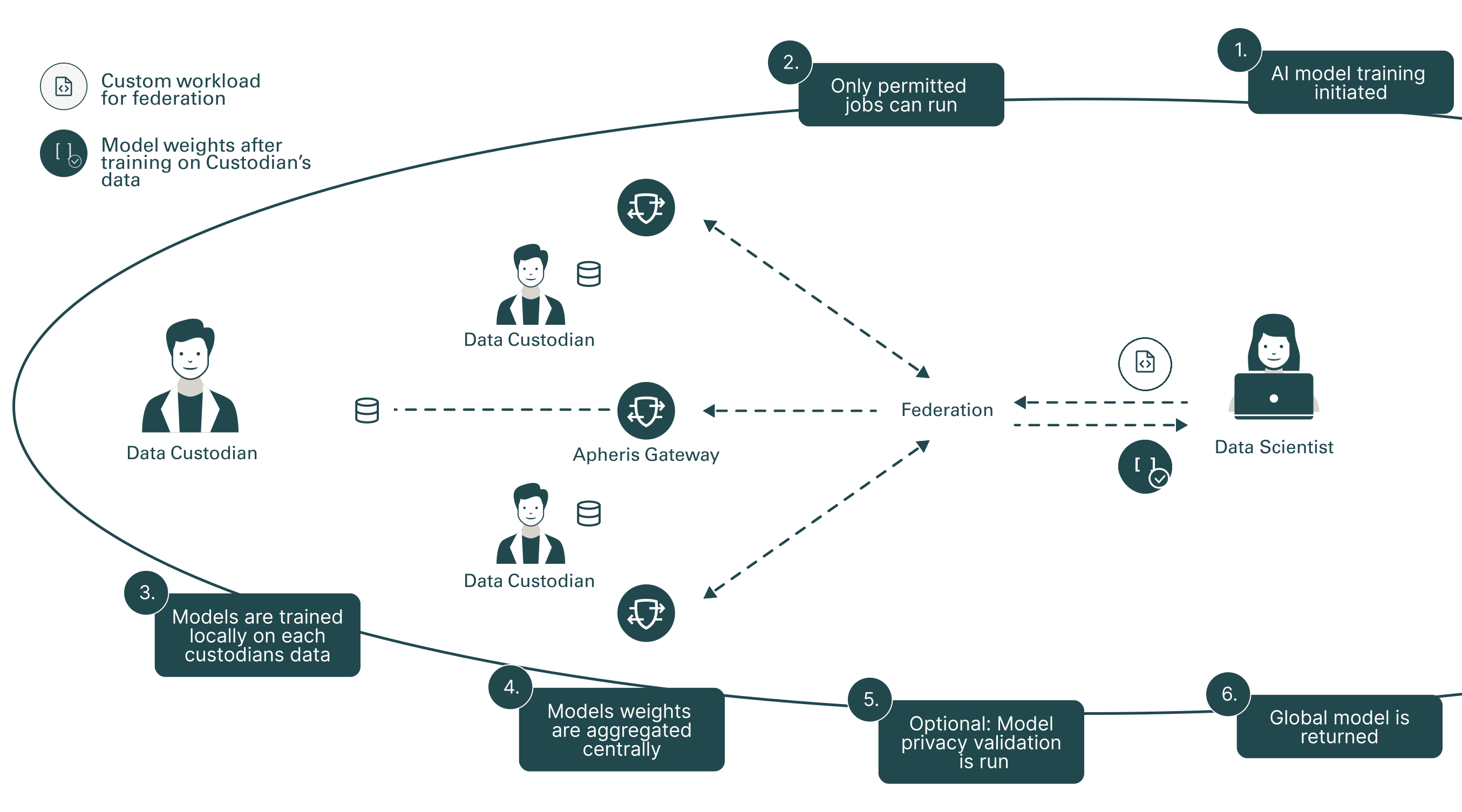
Each participating organization prepared its local structural data in a shared OF3-compatible format. Federated learning sends the model to the data rather than the data to the model, so each partner's structures stay in place while the shared model learns from all of them. Training used synchronous federated averaging: partners trained locally for a small number of steps, sent model parameters to a central aggregator (operated by Apheris using the Apheris Gateway), and received back the updated global model. Public PDB-derived data were mixed into training to stabilize optimization and prevent over-specialization to any one partner's distribution, using a cutoff of 2025-11-19.
The private structures remained inside partner environments throughout. The aggregator received privacy-preserving model parameters, not structures.
Data preparation and validation
Getting the data ready was one of the biggest challenges of the project. Each company has built up its structures over decades in its own in-house formats and conventions, so making them consistent and machine-learning-ready across partners was far from automatic. Apheris and the AlQuraishi Lab built a shared data-harmonization workflow to solve this; when one partner hit a formatting edge case, the fix was applied for everyone, and that workflow now makes onboarding much faster for new members joining the network.
Validation covered two levels:
- Data consistency: verifying that structures conformed to the shared data schema and were correctly annotated: molecular descriptions complete, crystal resolution values present, protein chains and ligand-protein interfaces properly labeled, and all standard building blocks accounted for
- ML-readiness: loading every structure through the full OF3 training pipeline in a dry run to confirm the dataset would work
Each structure was assigned an anonymized identifier, so per-structure failure information could be shared back with the structure owner for debugging without exposing the underlying data to Apheris or other partners.
Privacy assessment
We conducted a formal privacy risk assessment of the AISB-1-Fed models, covering the full federated workflow from training through model deployment. The assessment applied state-of-the-art attack methods from the machine-learning security literature, specifically data reconstruction and membership inference. The evaluation followed established practices for both attacks. Conditions were deliberately conservative and attacker-favorable, designed to maximize any detectable signal.
Empirical testing found no meaningful privacy risk across all five partners and both attack classes.
It helps to be clear about what membership inference can and cannot do. It cannot retrieve unknown compounds from the model; it can only test whether a compound the attacker already has, including its full experimentally determined 3D structure, was in the training set. An attacker who holds that level of structural detail is confirming something about data they essentially already have, not discovering anything new. True positive rates ranged from ~0.05 to ~0.32 at zero false-positive rate. This means the attack failed on the majority of queries, even under ideal conditions. Even a confirmed result reveals nothing beyond bare membership, with no binding data, assay results, or SAR context. Under realistic conditions, an attacker would lack ground-truth structural data and would face the combinatorial challenge of identifying relevant candidates across chemical space. In that setting, the practical risk is negligible.
Together, the technical and organizational controls in place support a strong privacy posture:
- Data locality: data stays inside each partner's environment, enforced by the Apheris Gateway.
- Role separation: between the data custodians, the model provider, and the infrastructure operator.
- Shared governance: over what data may be used and how results are shared.
- Contractual restrictions: on reverse engineering and reconstruction attacks.
Interpretation and limitations
The result should be read as evidence that federated fine-tuning improved performance on the participating partners' own held-out private structures. It is not a universal claim about all protein-ligand co-folding tasks. Several limitations apply:
- Scope of the evaluation: we report high-level aggregate metrics publicly, but the participating companies can examine performance case by case in their own environments, and finer breakdowns, for example by target class such as GPCRs or kinases, are possible. The more meaningful limitation is one of scope. This benchmark is deliberately weighted toward pharmaceutical protein-ligand data, so it speaks to industrially relevant targets rather than to the model's general chemistry understanding across the broader PDB, a fair caveat given the focus of the initiative.
- A partner-held-out benchmark, not a fully external test: the evaluation structures come from the same five partners that contributed training data, so this is a partner-held-out benchmark rather than a fully external test of protein-ligand co-folding. The split was made at the target/project level within each partner and fixed before training; measuring full cross-partner similarity is itself hard under federation, since the structures never leave their owners, which points to an opportunity for better privacy-preserving federated metrics. This initiative also focused on structure prediction alone, not yet on binding affinity or binder classification, both of which are a focus for the network's next initiative.
- Federated learning for co-folding is a genuinely new paradigm for the field: this is an early proof of concept with plenty still to do; the AISB Network is already driving research on these next challenges.
Summary
The Federated OpenFold3 Initiative shows that federated fine-tuning of OF3p2 across five pharmaceutical partners substantially improves protein-ligand co-folding on private pharmaceutical validation data.
On 1,056 held-out private structures (ranked selection):
- Frac PL-lDDT ≥ 0.8: 35.6% (OF3p2) → 52.1% (AISB-1-Fed), vs 40.9% for Boltz-2
- Frac bisyRMSD ≤ 2 Å: 28.9% (OF3p2) → 46.8% (AISB-1-Fed), vs 36.5% for Boltz-2
- Frac PPI-lDDT ≥ 0.8: 62.6% (AISB-1-Fed) on the 443-structure PPI subset, vs 40.9% for Boltz-2
The result is private, anonymized, and validation-only. Its significance is that it demonstrates that proprietary structural data distributed across organizations can improve a shared model without centralizing the underlying structures. The resulting model is also more accurate on the partners' own held-out structures, the data most relevant to their discovery programs. Beyond proving that federation can deliver superior model performance, AISB is set up as a repeatable capability rather than a one-off, with the standards, infrastructure, and governance established, making each further cycle easier and the model improving as more partners and modalities join.
Acknowledgements
We are grateful to the members of the AI Structural Biology (AISB) Network who contributed the data, expertise, and review that made this work possible: Dr. Payal Sheth (Bristol Myers Squibb), Dr. John Karanicolas (AbbVie), Dr. Paul Mortenson (Astex Pharmaceuticals), Dr. Gary Tresadern (Johnson & Johnson), and Dr. Prashanth Vishwanath (Takeda), together with their colleagues at each company. We thank the OpenFold3 team at the AlQuraishi Lab, whose model this work builds on and who were also deeply involved in the federated training. We also thank our technology partners at Amazon Web Services, whose reliable and scalable infrastructure underpinned the federated training and whose team was central to coordinating the compute across the network, with particular thanks to Dan Sheeran, Mourad Chaouch, and Ujjwal Ratan. Finally, we thank NVIDIA for the compute, and especially the NVIDIA FLARE team for the federated-learning infrastructure that supported training.
Disclosures
The authors employed by the participating pharmaceutical companies (AbbVie, Astex Pharmaceuticals, Bristol Myers Squibb, Johnson & Johnson, and Takeda Development Center Americas, Inc.) may hold equity in their respective employers, and the participating companies funded the consortium.
Prashanth Vishwanath and Edward King are employees of Takeda Development Center Americas, Inc. and hold Takeda stock. Takeda provided funding for the consortium.
Gary Tresadern is an employee of Johnson & Johnson and holds Johnson & Johnson stock. Johnson & Johnson provided funding for the consortium.
Main references
- OpenFold3 Preview 2 technical report: https://portal.openfold.omsf.io/reports/of3p2_technical_report.pdf
- ProtenixV1 preprint: https://www.biorxiv.org/content/10.64898/2026.02.05.703733v3
- Boltz-2 preprint: https://www.biorxiv.org/content/10.1101/2025.06.14.659707v1
- Advancing protein prediction with Federated Learning on NVIDIA DGX Cloud: https://www.apheris.com/resources/advancing-protein-prediction-with-federated-learning-on-nvidia-dgx-cloud
References